‘We are using automated tools to gather information from PVI providers’ websites.’ That line is in the Competition and Markets Authority’s update on its childcare market study, published on 25 September, in the table of what it has been doing. The same table records formal notices under section 174 of the Enterprise Act to more than 20 of the largest PVI providers, formal notices to a number of private equity investors in the largest PVI providers, and roundtables planned for October and November.
The CMA expects to publish an interim report in December with ‘emerging thinking on possible options for improving outcomes’, and will seek views on it. The same report will give its provisional view on whether to refer the sector for a market investigation, a longer process whose possible outcomes include remedies the CMA imposes itself. The final report is due in May 2027.
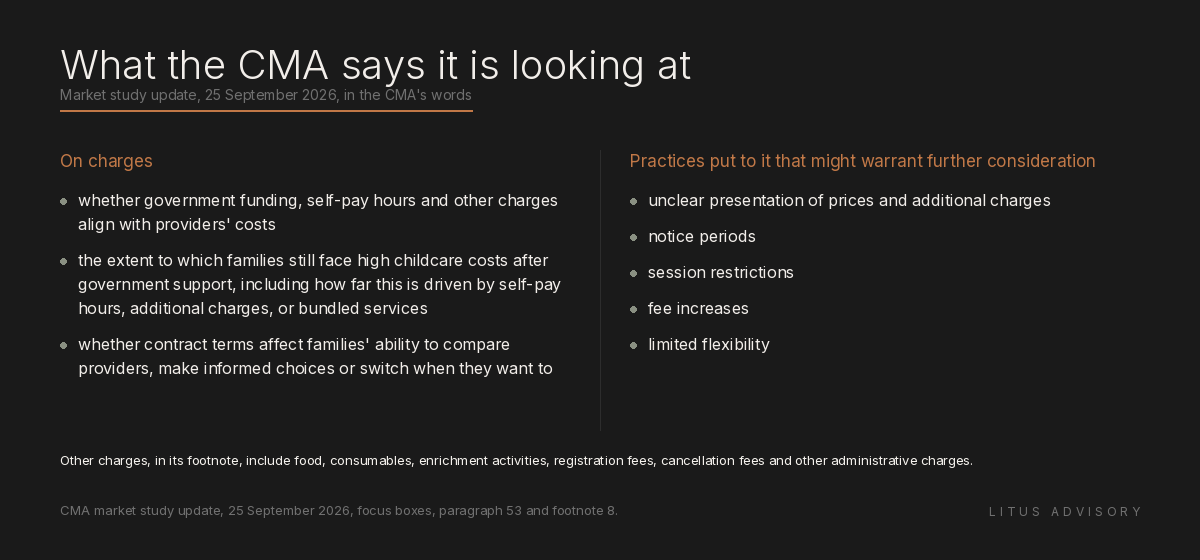
The update reaches no conclusions. On charges it is looking at ‘whether government funding, self-pay hours and other charges align with providers’ costs’, and at how far the high costs families still face after government support are ‘driven by self-pay hours, additional charges, or bundled services’. It is also looking at ‘whether contract terms affect families’ ability to compare providers, make informed choices or switch when they want to’. Its footnote on other charges includes food, consumables, enrichment activities, registration fees, cancellation fees and other administrative charges. Some respondents put practices to it that ‘might warrant further consideration’, among them ‘unclear presentation of prices and additional charges, notice periods, session restrictions, fee increases and limited flexibility’.
The most frequently raised point on information, from providers, professionals, local authorities and other stakeholders, was the word ‘free’. Respondents said the ‘free’ childcare terminology and wider government communications ‘could create expectations from families that did not reflect providers’ funding realities’.
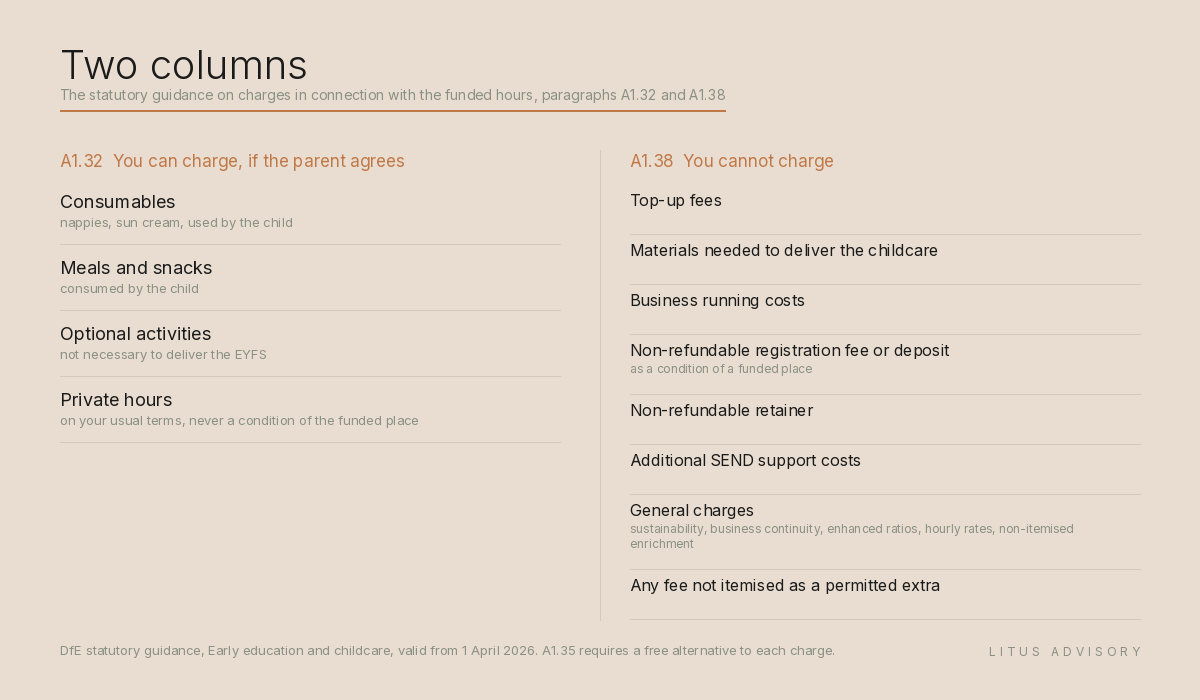
The rules are the Department for Education’s, in the statutory guidance to local authorities valid from 1 April this year, paragraphs A1.31 to A1.44. In connection with the funded hours you can charge for consumables such as nappies and sun cream, for meals and snacks, and for optional activities not directly related or necessary for the effective delivery of the EYFS, as long as each charge is voluntary. You can charge for private hours on your usual terms, as long as taking them is not a condition of the funded place.
Authorities must take all steps available to ensure you charge for nothing on the A1.38 list in connection with those hours. No top-up, and nothing for materials needed to deliver the childcare or for business running costs. A registration fee or deposit cannot be non-refundable as a condition of the place, there is no non-refundable retainer, and there are no additional support costs for a child with SEND as part of their entitlement hours. Then the general charge, for which the guidance gives these examples, ‘non-itemised enrichment charges, sustainability charges, business continuity charges, additional charges, enhanced ratios, hourly rates’, and then any other fee that is not itemised as one of the permitted extras.
The costs of chargeable extras should be on your website, or on the council’s Family Information Service if you have none, with the pattern of hours a parent can take the entitlement and a breakdown of costs as set out in the department’s template. Invoices should break down separately into funded hours, private hours, food, non-food consumables and activities. And if you offer the funded entitlements you are responsible for a policy that gives parents a reasonable alternative to the extras, including supplying their own or having the cost waived, and a parent who opts out must not be refused the place.
Seven checks to run before December, for each setting, on the website, which is what the CMA’s automated tools gather from, and on the parent contract. Local authorities told the CMA that national guidance could be interpreted differently locally, so a group in more than one authority runs them against the strictest reading it meets.
The fees page. Every chargeable extra has an amount against it, the hours pattern is on the page, and the breakdown is as set out in the department’s template.
The price list, line by line, into two columns, A1.32 and A1.38. Consumables, meals, optional activities and private hours in the first. Anything called sustainability, enrichment without items, enhanced ratio, an hourly rate on top of the funded hours, or a fee with no itemised extra behind it in the second. Each line in the second column goes. If it is a permitted extra under another name, it is itemised as that extra, priced, voluntary, with the opt-out. Price the gap before you relabel, because not all of it can be itemised as a permitted extra.
Registration fees and deposits. Refundable, or not a condition of taking up a funded place, and the wording says so. No non-refundable retainer on a funded place.
One real invoice for a funded child from each setting, with the parental declaration for the same child. The five A1.42 headings, and your full details on it.
The word ‘free’. Every place it appears on the site, the next sentence does not introduce a charge.
Notice periods, session restrictions and fee increases, read as a parent comparing you with another nursery. These are on the list respondents gave the CMA. If the notice period or the way fees rise is not on the fees page, it fails.
The opt-out policy. The one a parent can find on the site is the one your managers apply at the door.
The Budget document published on 28 October does not mention childcare, early years or nurseries. It sets the National Living Wage at £13.21 an hour from 1 April 2027, up 3.9%, and the 18 to 20 rate at £11.27, also up 3.9%. The business rates measures are for retail, hospitality and leisure properties. So the wage bill rises again in April, and the funding rate that has to carry it is set by the Department for Education, not in the Budget.
A1.31 says government funding ‘is not intended to cover the costs of meals, other consumables, additional hours or additional services’. A1.38 rules out a top-up. A1.32 lets you charge for meals and consumables only as a voluntary extra, A1.34 lets the parent opt out, and A1.35 makes you give them a way to take the place without paying for the extra. Where the parent opts out and the cost is waived, the provider carries it. That is who pays, and we put it to the CMA in July. Its update records that some respondents ‘highlighted potential inconsistencies between current statutory guidance on additional charges and the funding arrangements underpinning funded childcare’, and, in its paragraph on local authorities, that it heard the guidance ‘could be challenging to implement’. In our view that is the argument to make in the consultation on the interim report. Until the guidance changes, a sustainability charge or an hourly rate on a funded place is on the A1.38 list.
If you want this run across your settings before December, get in touch.