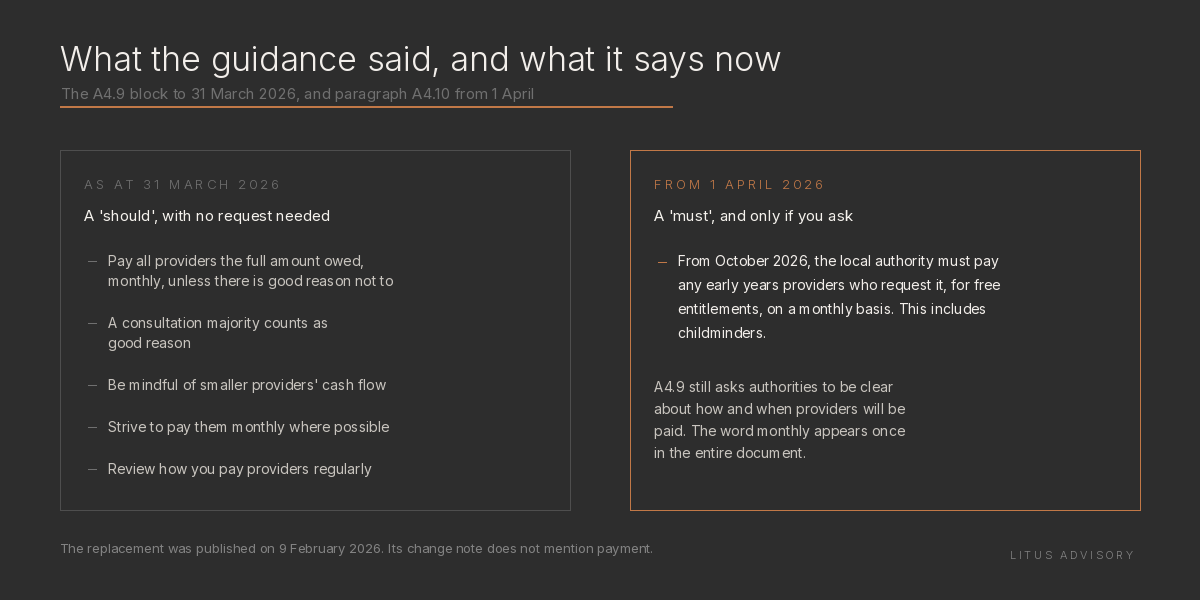
From 1 October your local authority must pay you monthly for the free entitlements if you ask it to. That is paragraph A4.10 of the statutory guidance in force since April, and in that guidance a ‘must’ is a legal obligation on the authority, not a recommendation. The 1 October date is in the dedicated schools grant conditions for 2026 to 2027, where the department describes the requirement as a new grant condition.
Monthly is not automatically better for you. Take an autumn term where your entitlement funding is £300,000 and arrives in one payment in early September. The funded autumn term runs September to December, so monthly on the same advance basis would pay you £75,000 at a time instead, and you would hold £225,000 less in September, £150,000 less in October and £75,000 less in November than you do now. If your authority pays you in advance like that, monthly costs you cash through the term. If it pays in arrears, or pays late, monthly helps you, because smaller payments mean less money owed to you at any one time.
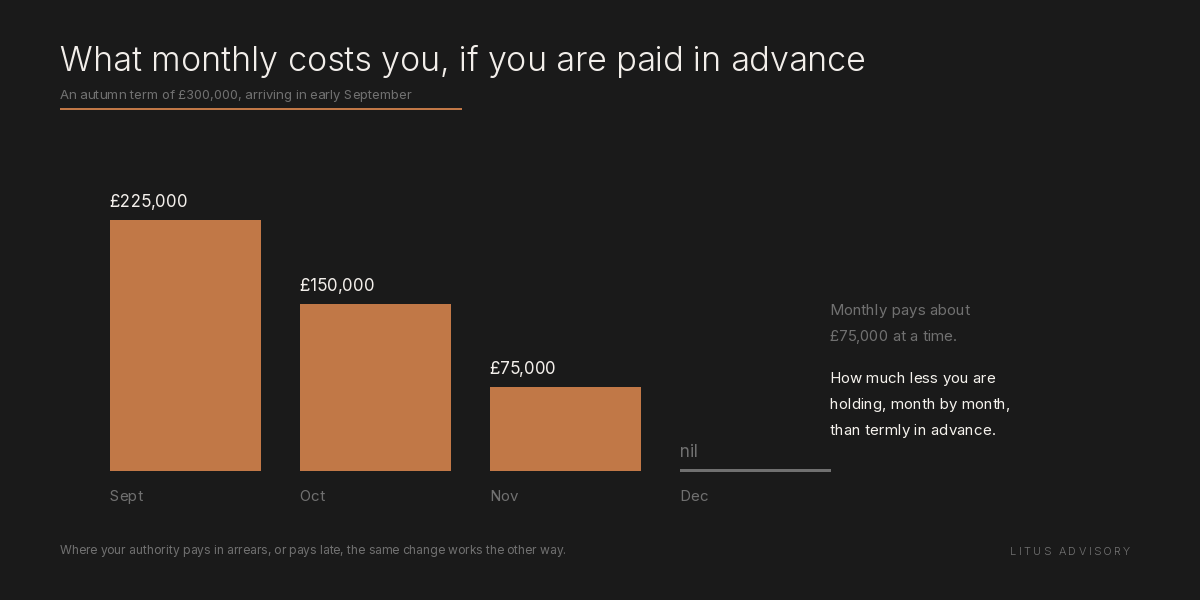
Whether monthly suits you is one question. There is a second, and nothing the department has published answers it. A4.10 says monthly and stops there. It does not say whether monthly means in advance or in arrears, and monthly in arrears can leave you worse off than termly in advance. So when you ask for monthly, ask in the same breath which of the two you are being offered. The letter further down asks both questions.
For each authority you deal with, put these on a page. Take the dates from bank statements rather than your cashflow forecast, because what you need is when the money actually arrived, not when you assumed it would.
What you are paid, and how many days after the first day of term the money reached your account.
How many days passed between the money arriving and the payroll run it had to cover.
The last two times your budget was recalculated on actual attendance, and whether money came back to you or came off a later payment.
Your current pattern against monthly, across a full year rather than one term.
If that page says your current arrangement suits you, do nothing. Asking is what triggers A4.10. If you never ask, nothing changes.
Nothing in the guidance says how to ask. There is no form, no deadline for you and none for the authority to reply, so put it in writing and keep the record. An email does the job. Here is a letter you can copy.
Dear [named officer, or Early Years Funding Team],
[Group name], [company number], provider reference [ref]. Setting: [name], URN [EYxxxxxx].
We are currently paid for the free entitlements [describe current pattern, for example termly in advance, in three payments].
We request payment on a monthly basis for the free entitlements with effect from 1 October 2026. This request is made under paragraph A4.10 of the Department for Education’s statutory guidance Early education and childcare (valid from 1 April 2026). A4.10 is expressed as a ‘must’. The department records this requirement as a new grant condition, applying ‘with effect from 1 October 2026’, at section 1.3 of the DSG conditions of grant 2026 to 2027.
Where we operate other settings in your area, please treat this as a request for each of them: [list, with URNs]. Where we operate in other areas we are writing to those authorities separately.
Please respond to each of the following by [date]:
Confirmation that you have received this request.
Whether monthly payment will be made in advance or in arrears, and the date in each month on which it will reach us.
The date from which monthly payment will start.
How this applies to funding already paid to us for the autumn term.
Whether you operate your own process for these requests.
Whether a request can be withdrawn later, and how.
[Name], [Position], [Email], [Telephone], [Date]
Send it to whoever runs your entitlement funding and copy whoever signs your provider agreement, unless your authority publishes its own process before October, in which case use that. If nothing comes back, chase it, then ask for the authority’s complaints procedure for providers, which A4.31 says every authority should have and should publicise.
Questions two, four and six are in there because nothing in the guidance, the grant conditions, the operational guide or the model agreement answers them. When your authority replies, it may cite A4.12. That paragraph makes the authority’s duty to fund the provider chosen by a parent conditional on the provider accepting the authority’s payment terms. Payment terms are not payment frequency, and A4.12 says nothing about how often you are paid.
Your authority may also tell you it pays termly because it receives the money termly. It does not receive the money termly. The department pays authorities the dedicated schools grant in twelve monthly instalments plus a thirteenth for year-end adjustments. And nothing the department sends authorities tells them to pay providers termly. The operational guide for the entitlements says nothing about payment frequency at all.
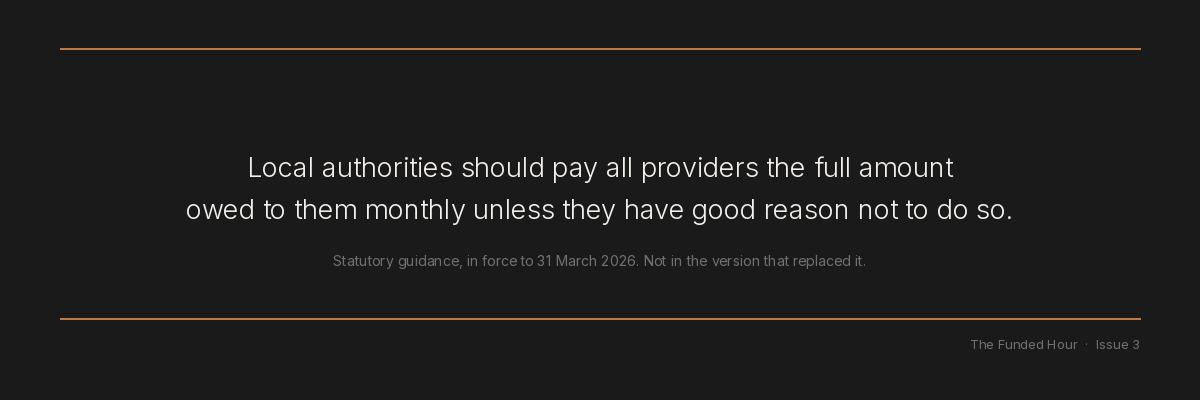
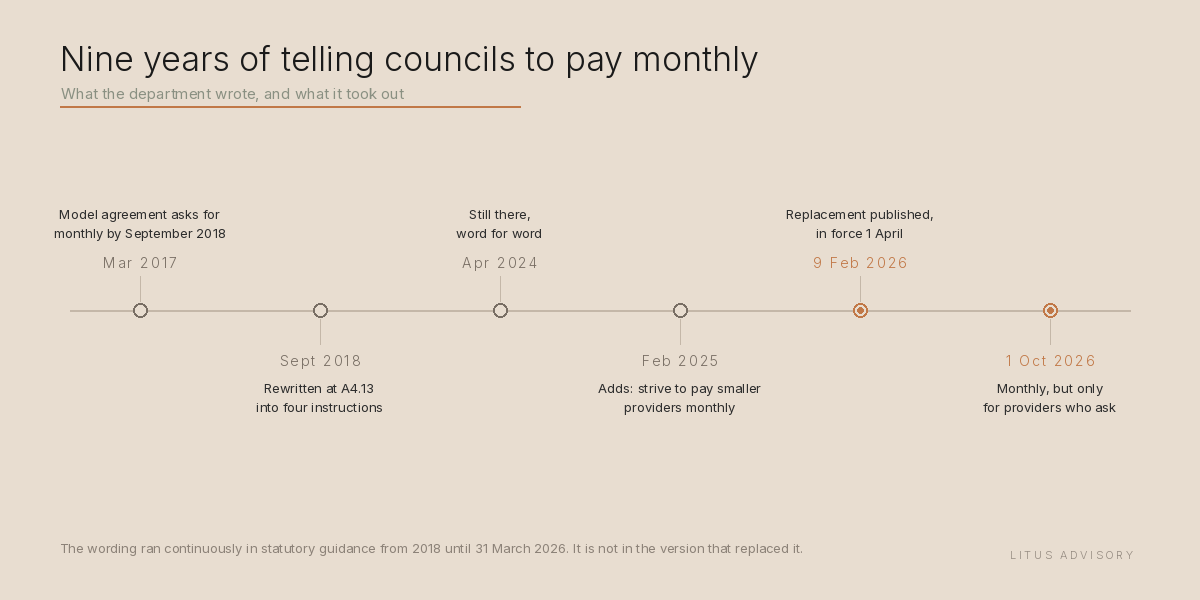
None of this used to depend on asking. Until 31 March the guidance told authorities to pay every provider the full amount owed, monthly, unless the authority had good reason not to. The one example of good reason it gave was a consultation in which most providers chose a different method. That instruction had been in the statutory guidance since 2018, and the version that replaced it on 1 April, published on 9 February 2026, dropped it.
The expectation is older than that instruction. The model agreement the department published in March 2017 told authorities to pay all providers, particularly childminders, monthly by September 2018, unless a provider asked to keep an existing payment method that worked and the authority agreed. In November 2017 Tracy Brabin asked the department what proportion of councils were paying monthly. The minister, Robert Goodwill, answered that all councils were expected to have moved by September 2018, and gave no proportion. None has been published since. Nine years after the department first asked councils for monthly, whether you get it depends on you asking.
If you want to work through what this change means for your own numbers, get in touch.