Every April, nursery owners across the country open their local authority funding letters and work out whether they can afford to keep going. If the rate went up, they feel a bit better. If it stayed flat or dropped in real terms, they start talking about sustainability and wondering whether the government understands what it costs to run a setting.
I have sat in those conversations across twenty five years in the sector, on both sides of the table, as an operator running groups and as an adviser working with investors looking at the sector. And the thing I keep coming back to is that the funding rate is not the problem. The problem is that most operators do not know what a funded hour costs them to deliver.
That number, the cost per funded hour, is the single most important figure in a nursery group’s P&L, and it is the one that almost nobody tracks. If you ask a nursery owner what their occupancy rate is they will tell you instantly. If you ask them their staff-to-child ratios they will know. But if you ask them what it costs to deliver one funded hour across their group, including the staff time, the room space, the admin overhead, the compliance cost, the meals, the consumables, and the management time that sits behind it all, most of them cannot give you a number. And that is where the margin leaks.
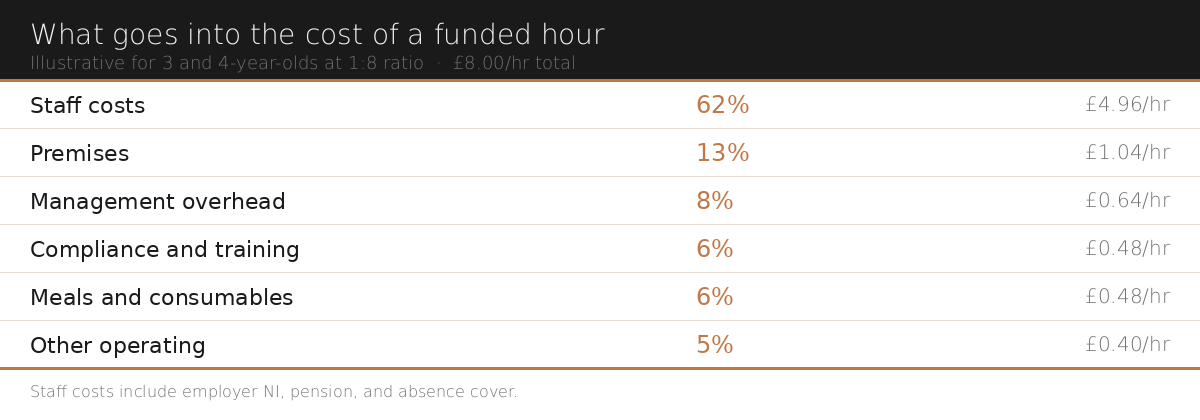
When you do not know your cost per funded hour, you cannot set fees that cover the gap between what the government pays and what it costs you to operate. You end up setting fees based on what the nursery down the road charges or what parents seem willing to pay, rather than what the economics require.

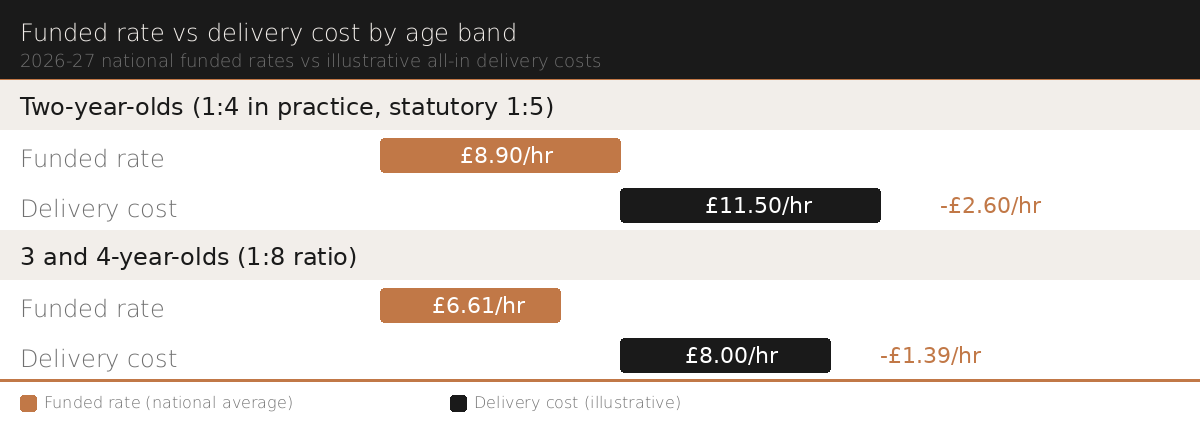
The age-band spread makes this worse than most operators realise. The national funded rate for a two-year-old in 2026-27 is about £8.90 an hour. For threes and fours the published rate is £6.61, though about 19p of that headline increase from last year is a technical adjustment for the move to termly census data rather than additional money for cost pressures.
The cost of delivering those hours does not follow the same pattern. A two-year-old at 1:4, the ratio most settings still run despite the statutory minimum moving to 1:5 in 2023, is cheaper to serve per hour than a baby at 1:3, but significantly more expensive than a three-year-old at 1:8. In one group I looked at recently, the all-in cost of delivering a funded hour for twos was running at about £11.50 against a national average funded rate of £8.90. For threes and fours the cost was closer to £8.00 against a rate of £6.61. The gaps are different in each room, and the cross-subsidy between them was invisible until somebody sat down and modelled it.
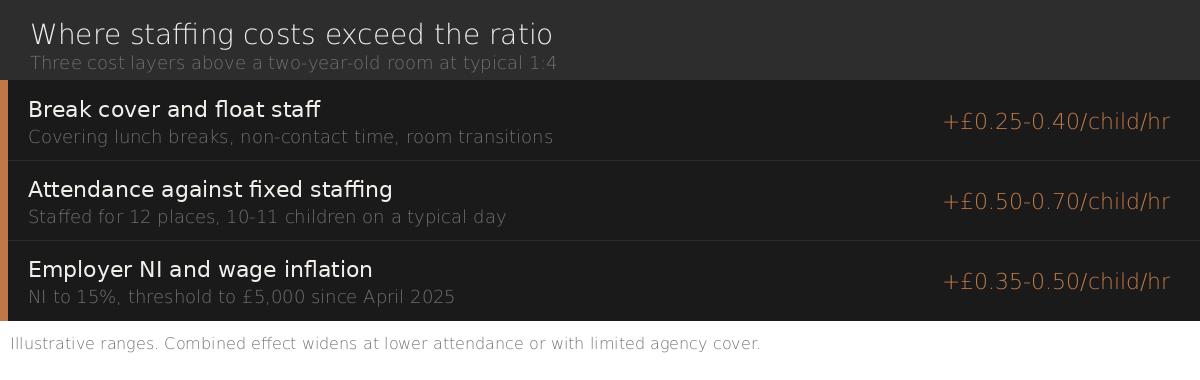
The gap between funded rate and delivery cost does not come from the ratio. The ratios are set by the EYFS framework and every compliant setting meets them throughout the day. The cost sits in what happens around the ratio. Your two-year-old room needs three practitioners for twelve children at 1:4, but those three need lunch breaks and the moment one steps out you drop below ratio unless a float covers. That float cost feeds into the cost per funded hour, and almost nobody tracks it. Add attendance variance, because you staff for twelve places but ten or eleven show up on a typical day and the staffing cost does not move. Then since April 2025 the employer NI increase and the National Living Wage rise have added roughly £2,600 a year per employee to a setting’s cost base, and funding rate increases have not kept pace with that cost pressure.
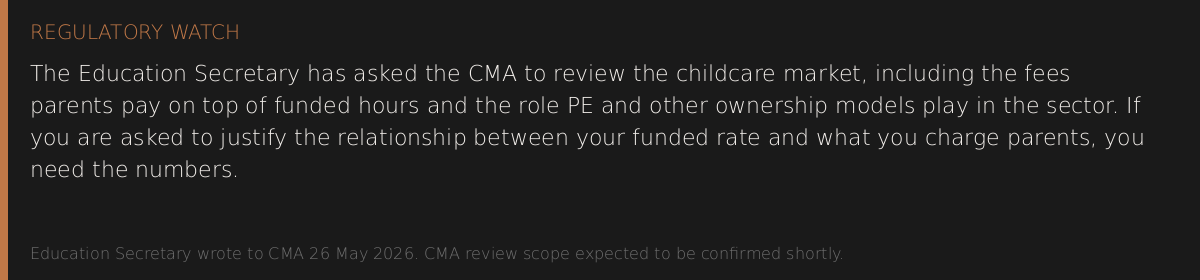
This is more urgent right now than it has been for years. The government review will look at market practices including deposits, consumables, and the gap between funded and fee-paying rates. If you cannot show what it costs you to deliver each funded hour, that is not a conversation you want to be having without the numbers.
This is also one of the first things PE investors look at when they evaluate a nursery group. Not the occupancy headline and not the revenue line. They want to understand the unit economics, and the cost per funded hour is the fastest route to seeing whether the group has margin leakage or untapped headroom. A group running at 85% occupancy with strong revenue growth can still have thin EBITDA if the funded hour economics are wrong, and that is a pattern we see more often than you would expect.
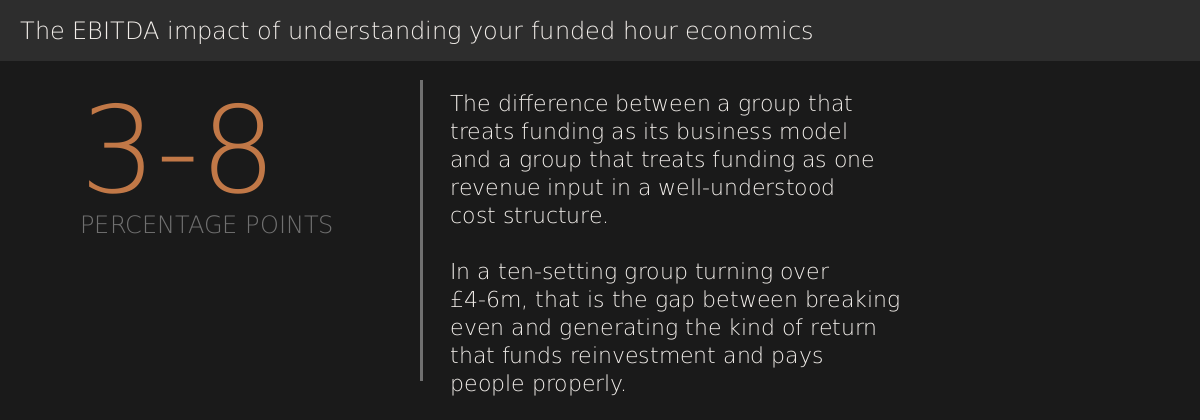
The funding rate is a given. It changes once a year and you cannot influence it. Your cost per funded hour is something you can measure and manage.
If you run a nursery group and you do not know your cost per funded hour by age band and by room, that is the first number worth finding. Not because the funding rate is irrelevant, but because everything you can control sits on the other side of that number.